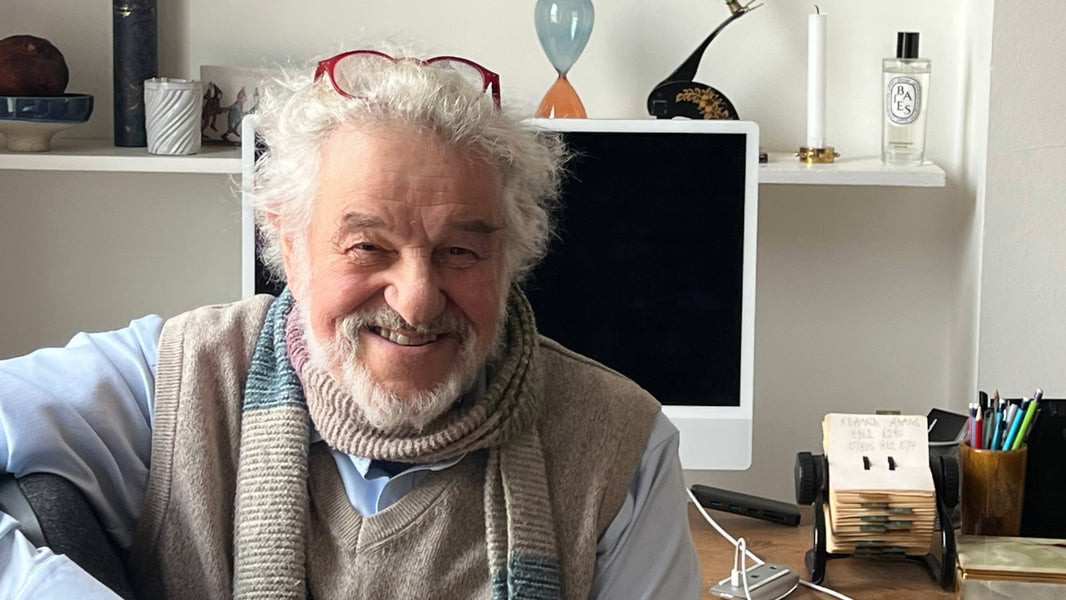


David Hockney’s gift – to help us see the world with fresh eyes and a sense of joy – made him one of the most lauded artists of our time. The announcement of his death in London on 11 June at the age of 88 has resonated worldwide and is being recognized as a generational milestone in British and international art circles.
In the spring of 2025, the largest-ever exhibition of David Hockney’s work opened at the Fondation Louis Vuitton in Paris – a glorious sell-out show of some 400 works representing the artist’s entire career. In the landmark book to accompany the exhibition, produced by Hockney’s long-time publisher Thames & Hudson, Sir Simon Schama wrote, ‘[Hockney’s work] is admired – loved is not too strong a word – by the millions who flock to see it because it presupposes an expectation of pleasure.’
David Hockney was always an autobiographical artist. He knew how to tell the story of his life in pictures, so it was fitting that he should choose to publish his autobiography in words and images with a publisher of the visual arts.
David Hockney by David Hockney: My Early Years, published by Thames & Hudson in 1976, was derived from twenty-five hours of recorded conversation between Hockney and his friend and editor Nikos Stangos. The book revealed Hockney’s thoughts on life and art and was an enormous success, both critically and commercially. The second volume of Hockney’s life story, That’s the Way I See It (Thames & Hudson, 1993), was a pronouncement of how an artist thinks, while also recording his anguish at the loss of many of his friends to AIDS – a moving reminder of the times.
Thames & Hudson recognized and revealed Hockney’s natural ability to reach a wide audience who might not necessarily count themselves as art experts. For Hockney, books provided another opportunity to communicate art and ideas as widely as possible and sometimes to express himself with others: with Stephen Spender in China Diary (Thames & Hudson, 1982); and with living writers as stellar and varied as T.S. Eliot, Doris Lessing, Gore Vidal and others in Hockney’s Alphabet (Thames & Hudson, 1991). Hockney’s original thinking was revealed in Secret Knowledge: Rediscovering the Lost Techniques of the Old Masters (Thames & Hudson, 2001), in which he investigated the use of optical devices by artists such as Van Eyck, Caravaggio and Vermeer; and again in the bestselling Hockney’s Pictures (Thames & Hudson, 2004), with Hockney’s own illuminating commentaries.
Martin Gayford, art critic for The Spectator, the Sunday Telegraph and Bloomberg News, was Hockney’s conversation partner and co-author for A Bigger Message: Conversations with David Hockney (Thames & Hudson, 2011), unravelling the problems and paradoxes of representing a three-dimensional world on a flat surface; and for A History of Pictures: From the Cave to the Computer Screen (Thames & Hudson, 2016), exploring the connections between film, photography, painting and drawing – a book that was also turned into an inspiringly clear and simple children’s edition (Thames & Hudson, 2018).
Like Vincent van Gogh, Hockney shared a deep ardour for the changing seasons. In 2019 the Van Gogh Museum in Amsterdam opened Hockney–Van Gogh: The Joy of Nature (the catalogue published with the same title by Thames & Hudson), the first time the museum had dedicated its special exhibitions wing to a contemporary artist.
In the spring of 2021, David Hockney and Martin Gayford collaborated again on Spring Cannot be Cancelled, published in defiant response to the Covid-19 pandemic. Their correspondence prompted Hockney to make the title’s life-affirming declaration of art’s capacity to divert and inspire, and present a hopeful vision of nature’s irrepressible beauty as he witnessed the arrival of spring at his home in Normandy, France.
In March 2026, the Serpentine Gallery, London, brought Hockney’s celebrated panoramic frieze A Year in Normandie to London for the first time. Inspired by the Bayeux Tapestry, this monumental work captures the changing seasons in Normandy.
Few artists have had the ability to affect so many people deeply with words as well as with pictures: with his constant sense of curiosity and probing self-awareness, Hockney was indisputably one of these. His many books continue to give lasting inspiration to readers of all generations, keeping us attuned to the reasons why we create, draw or look, and urging us to see and celebrate the extraordinary beauty of our world.
T&H won’t be the same without David. We all loved working with him and his teams over so many decades - The Neurath Family